Introduction to worflam beta
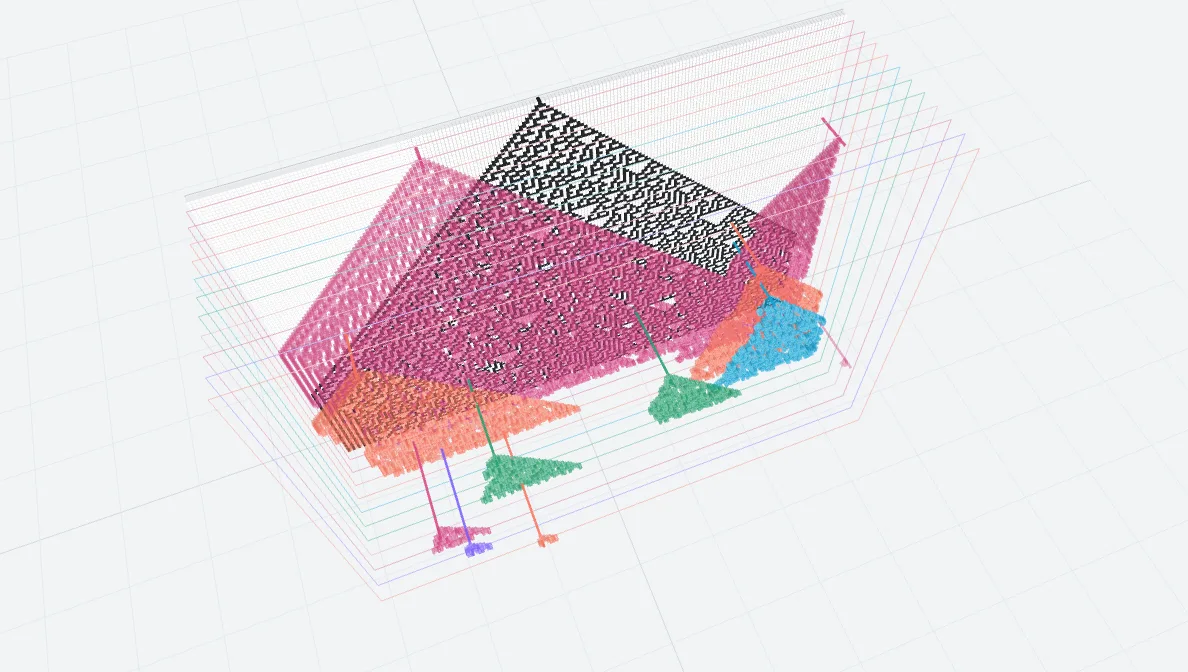
worflam beta is an interactive laboratory designed to study 1D Elementary Cellular Automata (ECA) subjected to stochastic noise. Instead of discarding mutated simulations or running them as isolated studies, worflam beta treats them as parallel, branching timelines.
What is an Elementary Cellular Automata?
ECA consists of a 1D grid of binary cells (0 or 1) that evolves through discrete generations. The state of each cell in generation t+1 is determined by its neighborhood (the cell itself and its immediate left and right neighbors) at generation t.
Because there are 8 possible combinations for a 3-cell neighborhood, there are 2^8 = 256 possible local rules (ranging from Rule 0 to Rule 255).
The worflam beta Paradigm
worflam beta shifts the cellular automata research from a single deterministic track to a branching state space. By introducing a probability of random mutations, it allows researchers to study perturbation growth, visual envelopes of error propagation, and state consolidation in parallel tracks.